Several studies confirming the efficacy of GLP-1 Receptor Agonist medications in reducing addictive behavior have been published recently. I’ve done my best to summarize their key findings in plain English below.
Retrospective Studies
Two retrospective studies show the tremendous promise these medications have for patients who’ve already been diagnosed with or are at risk of developing a substance use disorder (SUD):
Cai et al. (2026), "Glucagon-Like Peptide-1 Receptor Agonists and Risk of Substance Use Disorders Among US Veterans With Type 2 Diabetes," BMJ, March 2026.
Two very exciting findings were discovered by analyzing the medical records of 606,434 US veterans who were treated by the U.S. Dept. of Veterans Affairs (VA) for Type 2 diabetes over a median of 3 years. About 80% of these individuals had their diabetes treated with SGLT-2 inhibitors and the other 20% with GLP-1RA initiators. Since SGLT-2 medications don’t act on the brain’s reward system like GLP-1s do, this group can serve as a control group for the patients receiving GLP-1s.
The first analysis compared two groups of patients who did not have a pre-existing diagnosis of SUD. Among this group, those taking GLP-1s were 14% less likely to be diagnosed with an SUD in the following 3 years than those taking SLPT-2's.
A second analysis compared the outcomes for 81,617 veterans who, along with type 2 diabetes, had been previously diagnosed with SUD. To treat their diabetes, 16,768 started taking a GLP-1RA medication and the remaining 64,849 started taking an SGLT-2 inhibitor. The individuals who started taking GLP-1RAs had 31% fewer SUD-related ER visits and 26% fewer SUD-related hospital admissions than those taking a SGLT-2. They were also 50% less likely to die of a drug overdose or other SUD-related cause.
Lähteenvuo et al., "Repurposing Semaglutide and Liraglutide for Alcohol Use Disorder," JAMA Psychiatry, January 2025.
This study compares hospitalization rates for 228,000 individuals with alcohol use disorder in Sweden over a median time period of almost 9 years. Among this group, over half were hospitalized for AUD at some point during the study.
The research compares the rates of hospitalization for a person during periods when they were taking a GLP-1 drug versus periods when they weren't. It showed that people on semaglutide (marketed today as Wegovy and Ozempic) were 36% less likely to be hospitalized for an AUD-related condition during the times when they were taking the GLP-1 medication and 22% less likely to be hospitalized for a physical health issue. Interestingly, these results were much better than the comparable results for individuals on naltrexone, Campral or Antabuse.
Randomized Controlled Trials
Randomized controlled trials (RCTs) are the gold standard in research. Unfortunately, because they take so long to design and report, few have been published to date. Here are two early ones.
Hendershot et al., "Once-Weekly Semaglutide in Adults With Alcohol Use Disorder: A Randomized Clinical Trial," JAMA Psychiatry, April 2025.
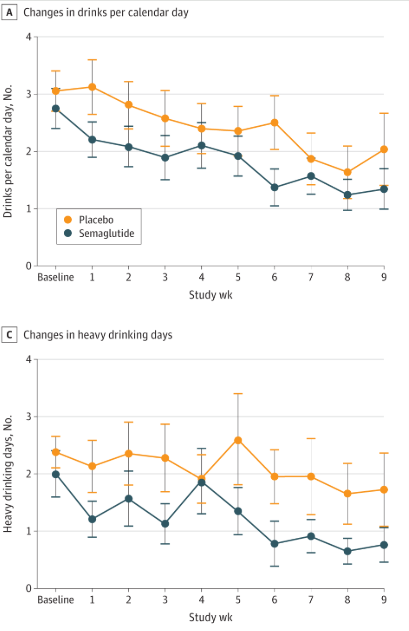
This was a double-blind RCT of semaglutide vs. a placebo among 48 individuals who were not seeking treatment, most of whom had a moderate AUD. The 24 individuals who received semaglutide received .25 mg in weeks 1-4 and .50 mg in weeks 5-8. About 2/3rd of these patients received 1.0 mg of semaglutide in week 9.
The average number of drinks per day decreased in both groups during the nine months of the study, with no significant difference between the two legs. However, the number of heavy drinking days (defined as 4 or more drinks for women and 5 or more for men) decreased significantly more among individuals taking semaglutide compared to the control group (see second figure below):
Klausen et al., "Once-Weekly Semaglutide Versus Placebo in Patients With Alcohol Use Disorder and Comorbid Obesity," The Lancet, May 2026.
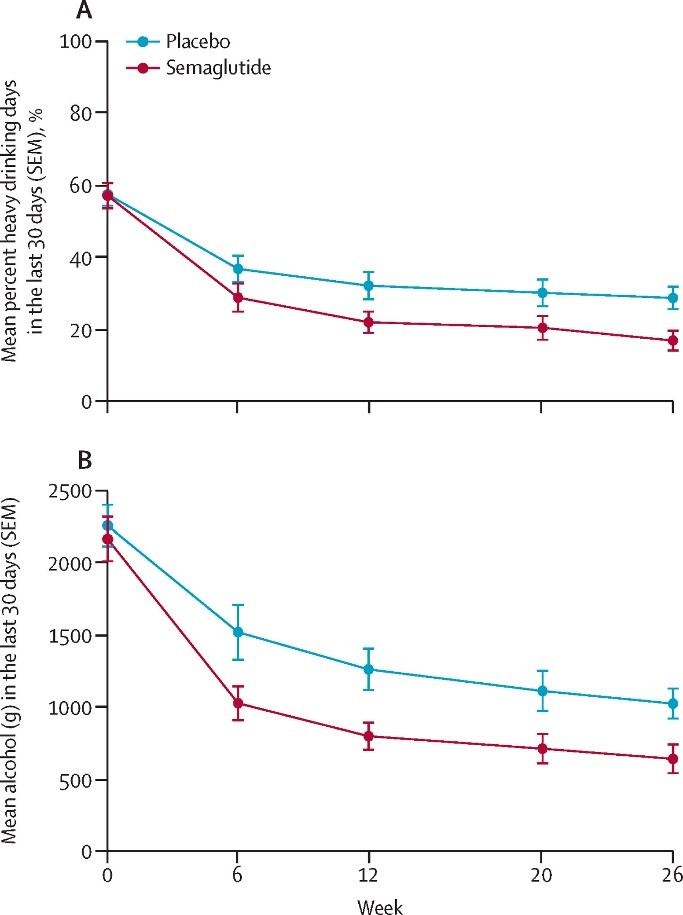
This double-blind 26 week study compared the outcomes of AUD patients randomly assigned to receive either weekly 2.4 mg injections of semaglutide or a placebo. All patients received cognitive behavioral therapy.
Patients receiving semaglutide reported a 41 percentage point reduction in their heavy drinking days (from roughly 57% to 16% of days) compared to a 26 percentage point reduction (from roughly 57% to 31% of days) for the placebo group. This difference is statistically significant at the 1% level (p=0.0015). Participants on semaglutide also lost significant weight and showed improvements in liver enzymes due to drinking less alcohol overall.
Note: Several of the Klausen study's authors disclosed financial relationships with Novo Nordisk (semaglutide's manufacturer) and other pharmaceutical companies, including grants, advisory roles, and consulting fees. The authors claim the funders had no role in the study's design or analysis.
Offering GLP-1 Medications to SUD Patients
Taken together, the research studies above indicate that GLP-1 medications offer substantial benefits to patients in treatment for SUD. If you’re interested in starting to offer GLP-1 medications to your patients, learn how Quel Health can assist you.