
As the potency of street drugs have exploded, levels of depression and anxiety have skyrocketed across the board, and reimbursement rates have stagnated, it has felt like the industry is falling behind in our battle to help more people recover from addiction.
I’m thrilled to finally be able to report some great news. GLP-1 medications like Mounjaro, Ozempic and Wegovy appear to help many individuals addicted to alcohol or drugs dramatically reduce their usage.
Research Findings
In the last two years, multiple large retrospective studies and small randomized controlled trials have showed the substantial promise of GLP-1s for treating addiction. For example, a retrospective study of veterans diagnosed with both type 2 diabetes and SUD found that those whose diabetes was treated with a GLP-1 medication were 50% less likely to die of an SUD-related cause than those treated with a different medication.
These very positive results aren’t surprising when we understand how GLP-1s work on the brain.
How GLP-1s Reduce Addictive Behaviors
Our brains are wired to chase what feels good. The dopamine hit we get when we eat, have sex or connect with other people is what drives the behavior our species needs to survive. Unfortunately, this reward pathway gets hijacked in addiction. The brain stops treating reward as a signal and starts treating it as a demand. Whatever spikes dopamine — a drink, a drug, a behavior — gets marked as essential. The brain asks for more of it, more frequently, regardless of the cost.
GLP-1 medications work by interrupting this reward pathway. Interestingly, every part of the brain's reward circuitry contains GLP-1 receptors. When these receptors are filled, the brain feels satisfied and cravings go away. People stop chasing their next dopamine hit, not because their willpower is stronger, but because the system driving the chase has gone quiet. As one SUD patient reported, “my brain listens to me now”.
Offering GLP-1s to Addiction Treatment Patients
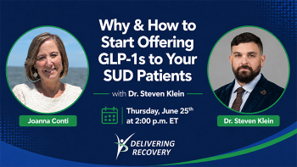
Dr. Steven Klein, an Addiction Medicine physician at Caron Treatment Centers, is at the forefront of translating these medications into real-world addiction treatment settings. He and I spent 35 minutes together recently discussing the reasons addiction treatment centers may want to offer these medications to their patients as well as solutions to the challenges centers will face doing so. You can watch our fascinating Delivering Recovery discussion here:
The first challenge treatment centers face is the expensiveness of the GLP-1 medications themselves, which health insurance companies are unlikely to cover.
Dr. Klein’s protocol starts SUD patients on very low doses of GLP-1s and slowly titrates up dosages for patients who need more. Patients are typically started at .40 mg, then increased to .45 mg, .50 mg and .60 mg as necessary. Since patients taking GLP-1s for diabetes or weight loss often take much higher doses than this (doses up to 2.4 mg/week are common), Eli Lilly and Novo Nordisk don’t offer versions of their medications at most of these interim levels.
Since the patent holders don’t offer the medications in all the dosages required, nor with the additives like B12 that are particularly helpful for people who’ve struggled for years with addiction, Dr. Klein works with compounding companies to produce low-cost versions of these otherwise-unavailable medications.
In addition to quieting cravings for substances, these medications also quiet cravings for food. Therefore, a second challenge a prescriber faces is making sure that patients taking GLP-1s are getting the nutrients they need and not losing too much weight. The need to continue prescribing these medications to patients after they leave addiction treatment is a third challenge facing short-term addiction treatment centers.
Dr. Klein has co-founded Quel Health to make it easy for treatment centers to offer these medications to their patients. Quel Health physicians will prescribe GLP-1s to a treatment center’s patients for $250 to $350 per month, which includes the cost of the medication. They'll meet with patients via telehealth, monitor the patient’s weight and be the point person for any side effects the medication may cause. Quel doctors continue to treat patients for as long as they are on the medication, regardless of whether they are still in SUD treatment or not. The compounders Quel Health works with ship the medications directly to the patients.
A second alternative Quel Health offers is to provide start-up advice to treatment centers who wish to use their own Medical Directors to prescribe GLP-1s.
How Vista is Supporting This Revolutionary Advance
When I talk to long-term Vista clients, the passion their leaders feel for helping their patients recover always shines through loud and clear. Therefore, I anticipate that many members of the Vista Research Network will be early adopters of GLP-1s.
We’re going to do our part too. Within the next week, Vista will begin monitoring GLP-1 use in our outcomes research the same way we do other anti-craving medications like buprenorphine, naltrexone and Vivitrol. This will allow our clients to monitor their patient’s weight and happiness with these medications in real time. This will also allow Vista to compare the post-treatment abstinence rates of patients using GLP-1s to those using other anti-craving medications or no medications at all. Interestingly, quite a few patients in Vista's research already report taking GLP-1s.
Are You Ready to Start Offering GLP-1s?
While GLP-1 medications aren't a magic bullet, the research shows that they make it easier for many people to recover from addiction. I encourage you to weigh the potential benefits of offering your patients these medications against the risks, and to move as quickly as you feel you responsibly can. Please let me know any way Vista can help.