As of January 1, 2018, all Joint Commission-accredited behavioral healthcare organizations are required to use Measurement-Based Care.
Joint Commission's standard CTS.03.01.09 sets three overall requirements:
Use standardized tools or instruments to monitor how patients are progressing from Intake through discharge
Use the data generated by the tools to inform clinical care and identify those patients not progressing as well as expected
Aggregate the data periodically to evaluate whether your organization is improving over time
Easily Comply with Joint Commission Requirements
Vista’s progress monitoring software makes compliance almost effortless:
Patients are screened online for depression, anxiety, trauma, eating disorders, suicidal thoughts and self-harming behavior using academically-validated screening questions and scales such as the PHQ-9, GAD-7 and Columbia Suicide Severity Rating Scale.
All data is displayed in real time in color-coded patient graphs on Vista’s patient dashboard. Counselors and center management can choose how and when to be notified of new submissions.
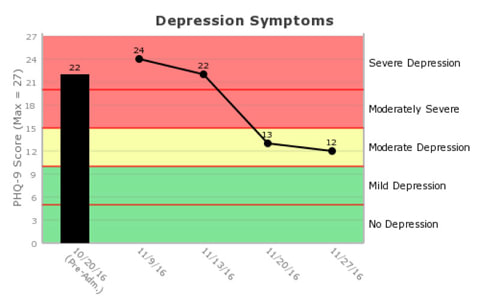 |
Patients are reassessed on whatever schedule your clinicians recommend using customized surveys that only take about 5 minutes to complete. For patients with access to smartphones or the internet, Vista can text or email them directly when it is time for a new survey to be completed.
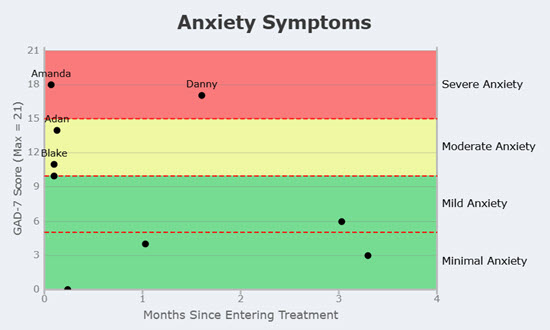
Real-time summary reports make it instantly apparent which patients are not progressing as well as expected.
 |
- In addition to 60+ other aggregated metrics, Vista's data analytics platform shows how the severity of your patients' co-occurring disorders improved between their first survey at intake and their last survey before leaving treatment:
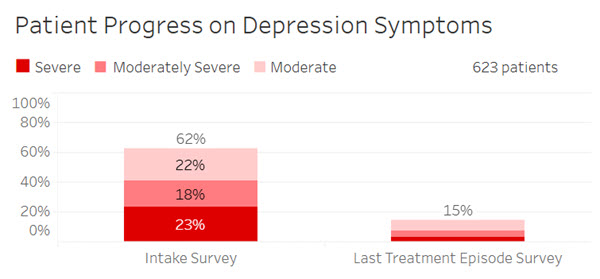
Your data is analyzed in a comprehensive (30+ page) annual Treatment Effectiveness Report so your management can see how your center compares to national norms, whether your results are improving over time, and how results vary by program and clinician.
Preparing for a Joint Commission Accreditation Meeting
If your team has been using Vista for awhile, you are already well prepared for the Outcome Measures questions the surveyor is likely to ask. I would prepare for the meeting by doing two additional things.
First, you'll want to prove that your clinicians are using the data to inform clinical care. I'd suggest pulling charts from your implementation report and from the Audit tab on the data analytics platform showing the following:
The percentage of your patients being enrolled in INSIGHT
How frequently update reports are being submitted
How frequently each clinician is logging into INSIGHT to view patient reports
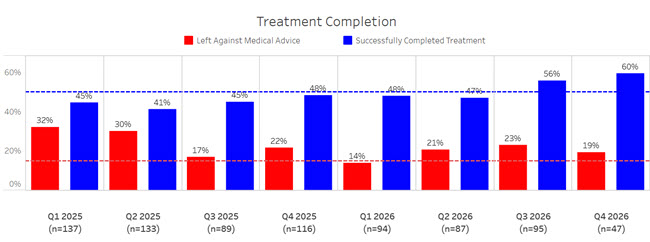
Separately, I would pull together information on the performance improvement goals you've set. For example, perhaps you set a goal last year to reduce the number of patients leaving AMA from the current 23% to 15%:
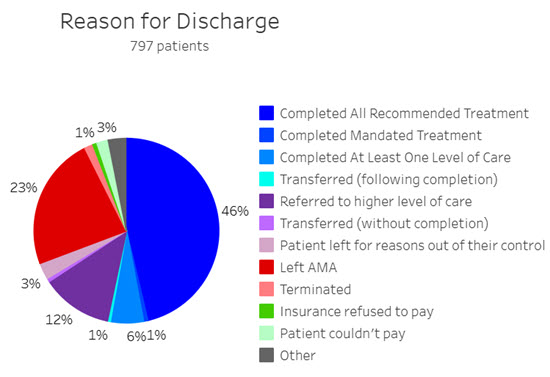
The Trends Overall tab of Vista's data analytics charts the progress you've made over time on meeting this goal:
As for proving that your clinicians are using outcome measures to improve clinical care, you should be in good shape. For example, I received a call from a client right after the completion of their Joint Commission reaccreditation interview. The client told me that one of the patients the surveyor randomly selected had reported on a Vista update survey that she was having suicidal thoughts with some intention to act on them. The patient’s clinician, having received a Vista alert, took action immediately and documented her response in the electronic medical record. The surveyor was extremely impressed by this demonstration of clinician response, and this set the stage for a very positive meeting.
You can learn more about how easy Vista makes it to comply with the Joint Commission Outcomes Measures standard by watching Vista's demo.