

Treating addiction is hard enough with patients who recognize the terrible impact their substance use has had on their lives and never want to use again. Treating the many patients entering treatment for cannabis use disorder who don’t want to stop using it makes a therapist’s job tremendously more challenging.
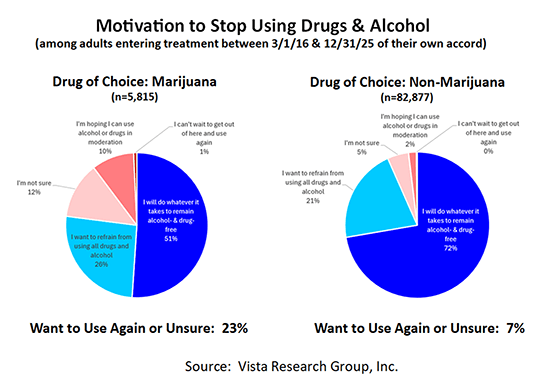
Excluding patients who are required to attend treatment, 93% of adult patients who enter short-term therapy-based treatment addicted to a substance other than marijuana say they want to stop using alcohol and illicit drugs entirely. Only 7% say they’re not sure or are hoping to continue using alcohol or drugs in moderation. However, among patients whose primary drug of choice is marijuana, 11% admit that they want to continue to use alcohol or drugs after treatment and another 12% aren’t sure:
Factors Affecting Motivation
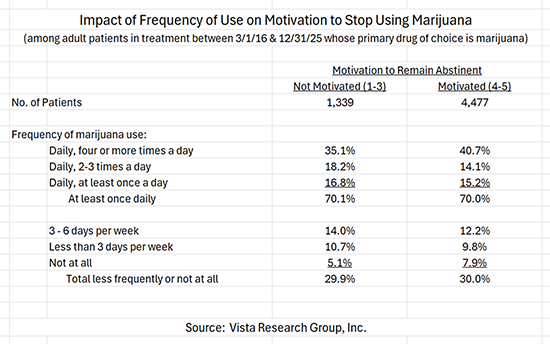
Interestingly, there is little difference in the frequency of marijuana use between patients who want to stop using entirely and those who don’t. In both groups, 70% of the patients report using marijuana every day, often four or more times each day. (Patients are told to consider two use episodes to be separate if they are at least an hour apart):
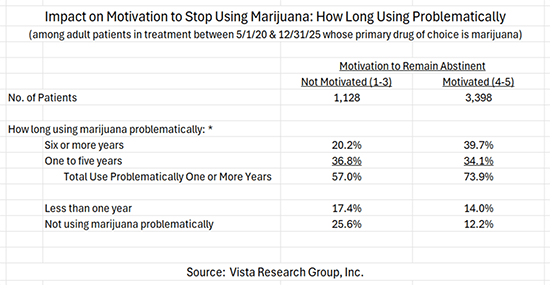
The main difference between those who recognize the need to stop using and those who don’t is how long they have been using marijuana problematically. Almost twice as many patients (39.7%) who are motivated to remain abstinent admit they’ve been using marijuana problematically for six or more years compared to only 20.2% of the patients who aren’t committed to quitting:
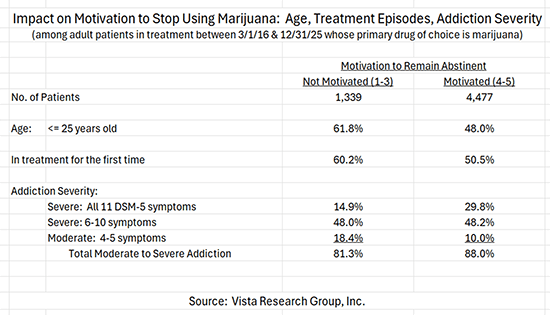
Because the length of time they’ve been using marijuana problematically is so crucial, less motivated patients tend to be younger, in treatment for the first time, and to have experienced fewer of the DSM-5 symptoms of substance use disorder in the prior year compared to patients who are committed to remaining abstinent:
Helping unmotivated patients commit to stopping marijuana use is one of the hardest skills to develop in addiction treatment—and one of the most important.
There is no single technique that reliably moves patients from ambivalence to commitment. Progress is often slow, nonlinear, and easy to miss in the moment. But understanding who these patients are—and why their motivation differs—gives clinicians a clearer starting point.
In cannabis use disorder, motivation isn’t a side issue. It’s the work. Let me know any way we can help.