[Joanna]
Welcome to our next forum. This is the second forum of “Delivering Recovery”. Today, I'm going to talk to Chris McIntosh, who's CEO of Turning Point Centers in Utah, about his center's journey from using anecdotes about patients to becoming patient-driven.
So we're very happy you're here. So I'm going to start out, Chris, just kind of asking you to set the stage. You started using Vista in January of 2019.
So can you talk a little bit about why you decided to move to doing a better job monitoring patient comments, and how you were making decisions prior to that point?
[Chris]
Yeah, sure thing. Great question, Joanna. So just to kind of provide a little context and give a very short version of the Turning Point story, the company, we're located in Salt Lake City, Utah.
We serve all adults. Currently, we have five residential facilities, 76 beds, two outpatient sites, 48-bed transitional living, and we do both primary mental health and dual diagnosis in their own separate settings with their own separate tracks. I've been with the company since 2010.
Met you 2017, 2018. As you stated, we onboarded with Vista early 2019, and what prompted us to look at adopting Vista was we were Joint Commission accredited. Joint Commission created a new standard that treatment programs needed to track their outcomes, right?
And so it all just began as a simple regulatory requirement. How do we meet this standard? How do we stay compliant?
Had no idea where it was going to lead us, to be completely honest. We literally just wanted to check a box, right? As we often do so many times with these regulatory requirements.
What was also going on at the time is Turning Point Centers, which was privately founded by three local individuals, they had decided to divest their interest in the business, and Turning Point was up for sale. So we got acquired by a private equity sponsor based out of New York, InTandem Capital. And part of their desire in acquiring Turning Point was they really wanted to elevate the standard of behavioral health. They wanted to bring in some more mainstream healthcare standards, which does include measuring outcomes and being able to rep to the work that you do and the services you provide.
And so that was sort of how the stage was set for us to begin using Vista. Now, I think the reason that we went with Vista originally was because, one, you had a very compelling product. It was turnkey.
You kind of took the guesswork out of it, right? Because when we thought about how are we gonna track our outcomes, it was spreadsheets and a couple of people, like frontline staff making calls in their downtime, right? When does frontline staff ever have any downtime?
And so we really didn't have the infrastructure to be able to do it with any real integrity, if you will. Yeah. The PE firm was, they spent like three or four years diligencing the behavioral health sector, and they were blown away by the lack of sophistication of behavioral health at the time.
They could not believe that not only did these large, very reputable behavioral health programs and organizations not have outcomes data, but that the industry had not standardized outcomes data, and that the payers themselves did not have the data infrastructure to measure our success or failure. So, you know, it wasn't that long ago, it was truly the wild, wild west. Yeah.
Yeah.
[Joanna]
So once you brought in Vista, change is always hard. What challenges did you run into trying to implement data driven treatment?
[Chris]
You know, I like to joke around with the staff here that, you know, the only thing we do is facilitate change for others. And, you know, the cobbler's kids have no shoes. Behavioral health organizations can be a little bit challenging when it comes to change management, so to speak.
I think all organizations, but I think it's kind of an ironic aspect of who we are and what we do. So I think, you know, the first challenge we faced was adoption, of course. And we all know that change management best practices. 80% of initiatives fail because we fail to capture hearts and minds.
We just don't do a good job as leaders explaining the why. Right? We approach our staff, we say, hey, we're gonna do this new thing.
It's a requirement. Don't ask a bunch of questions, just do what we ask you to do. And then a couple months later, we're scratching our heads going, why can't the staff figure it out?
And we really have no one to blame but ourselves, right? So our first challenge was adoption. Not so much getting everyone trained in the nuts and bolts, but really getting them bought in as to the why.
And at Turning Point Centers, you know, we're like a lot of treatment programs, you know, the majority of our staff are the clinicians. Therapists by and large, you know, they're not naturally inclined to track data. They're not like engineers or scientists, so to speak.
I think that their gift is really being able to root around in the human psyche and identify opportunities for people to challenge their maladaptive belief systems and try to create, you know, healthier coping strategies, right? And there's really no like, if this, then that to affecting, you know, good therapy and positive change. So when you throw a bunch of data and a bunch of numbers and a bunch of statistics at them, their initial inclination is kind of to go like this because they're really oriented to working in this non-rational realm.
And I want to be very clear, non-rational is not irrational, just non-rational meaning the world of emotions and feelings and beliefs. And so, you know, our first challenge was really trying to get them to understand what was in it for them, what was in it for the patients, and how this could all help us come together to just do a better job affecting positive change. The turning point, to be a little cliche for us, was I had a therapist named Dave, very talented guy, very passionate.
I mean, this is the guy that any time he thought there was gonna be a decision or some condition that was gonna impact the well-being of the patient, he would be up in the administration's office just advocating on behalf of the patient. You know, I love people like that. And Dave was also a very emotional person.
He's very touched by his experiences working with the population, and just a very, very great guy. But he, at the time, we really hadn't figured out the kind of optimized step-by-step process for deploying the Vista Insight Surveys. And originally, the way we decided to do it is the therapist would conduct their one-on-one session.
We were doing three one-on-one sessions per week at the time in residential, but they would pick one of the one-on-one sessions, and they would meet with the patient for 45, 50 minutes, and then at the end of the session, they'd administer the survey, the check-in survey. And so Dave sits down, he has the session. It feels like a very good just session, nothing out of the ordinary.
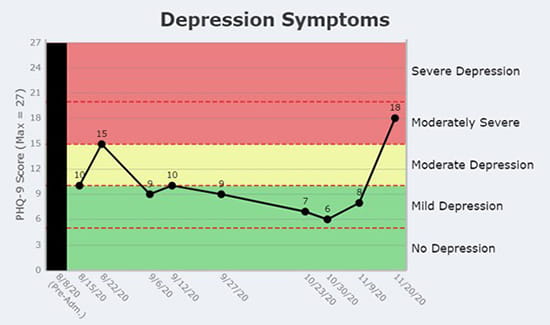
And after the session, he goes back to his desk, and he gets one of the Vista alerts that lets him know that one of his people is at risk. And he's like, oh, what's going on? And so he drills down into the email, and it's the patient that he just met with!
And this patient is reporting very high levels of suicidality, very dark and depressing thoughts. And Dave, he's caught a little flat-footed because he's like, none of this just came up. We had a very benign, very run-of-the-mill, very unremarkable session.
I can't believe this person is experiencing symptoms this severe. And it helped him realize that maybe, as great as I am as a therapist, and thank God Dave had this humility in this moment because he brought this wonderful insight to our organization. Maybe I'm not always able to get the whole story, and maybe it's not about me. And so we made one very small but significant change where now we start administering the survey at the very beginning of the first session of the week.
And that would set the tone for the whole course of trajectory of therapy for that week. And if the person was really struggling with some domain, you know, one of the measurements in Vista, then we could attack that directly and make that the focal point for the week. And so it really changed the way we approach patients, the way we address problems identified in the treatment plan, and it heightened our awareness that, hey, sometimes patients may be experiencing things in the milieu that they're not capable of telling us, or maybe we're not providing the opportunity for them to open up and articulate.
And so it just became a very great tool for there to facilitate trust and transparency in a unique way.
[Joanna]
Oh, fantastic. And so what changed after, I assume Dave told the story to the other clinicians?
[Chris]
So what was great is Dave became the biggest spokesperson for Vista. And now it was no longer the administration and our sort of, for lack of a better term, weak narrative of, hey, you need to do this because it's a regulatory requirement and we're paying for it, and hey, data's just a good idea. And we were able to say, hey, look, look at this specific example.
Look how it increased our awareness of what the patient is experiencing. Look how it changes our ability to quantify and address risk in real time. And we're in Utah, it's a Rocky Mountain state.
By all measures, we deal with a higher level of suicidality than the contiguous 48 states and so it really just created more awareness. It created a sense, it created more confidence in us that we knew what was going on with our patients and it really just changed the approach. But the most important thing is now that it was one of the therapists that had picked up the message and had a very resounding why, it got the rest of the group on board.
And it also gave us a very replicable, reliable, process-oriented framework. How do we leverage this tool in the best possible way and what's the right timing to get the right information? And it just, it was a pivotal point in our understanding of how tracking outcomes can really come to life within the confines of your treatment program.
[Joanna]
Do you think that was just a one-off situation with Dave's patient or did you find that sort of thing rather frequently that you would find things on Vista that you may not have identified before?
[Chris]
You know, over the years, we have made discoveries by leveraging the Vista tools that we may not have otherwise found. We never had a situation so dramatic that the person was reporting high suicidality and there was an immediate need to address that patient's risk. Because we immediately got everybody together and we let Dave tell the story and when Dave told the story, everybody was bought in.
And so we memorialized this in written process and we just constantly messaged, hey guys, please administer this survey, this weekly check-in survey. The other thing that we did that was very important was we baked it into our quality reporting every month and we used the Vista reporting tool so we could say, hey, we had so many patients, they were here so many weeks, we should have got X amount of surveys over this time period. We set a benchmark of 90%.
We wanted 90% of that number to be done every month like clockwork in order to practice good fidelity. And then we measured it by site, by clinician, by patient, month over month. We reported that in our internal quality meetings.
If we had a trending deficiency, which is the Joint Commission best practices, best practice, we had a written process improvement plan and that really helped us make sure that every patient was getting meaningful engagement via Vista.
[Joanna]
Did you have any surprises when you first started getting patient data? Was anything different than you expected?
[Chris]
Well, I'll tell you, once you move off, once you stop being more about mom and pop shop, sort of a feel good, break your arm, pat yourself on the back with how great your treatment is type stuff, right? And you get into some objective dispassionate data, it can be a little bit humbling, right? Because like when we were small, we decided to just do this little snapshot analysis of our completion rate.
And during that particular time period, we had unbelievable completion. We had very low AMAs, very low administrative discharges. The stars aligned, all the ingredients were right.
And it just so happened that 94% of our people during that very short time period -- I wanna emphasize that this was not the right way to measure it back early on -- it was probably like 2012, 2013, we did this exercise. And so we all thought, wow, we got a 94% completion rate and we parroted that 94% completion rate ad nauseam.
And I know for a fact, I was on the phone working with families, introducing them to Turning Point and other options, and I would use that 94% statistic, but then I would see evidence in my data later on that that wasn't always true. And I kind of didn't feel great about it. You know what I mean?
So when we actually got the data and we saw, how effective are we at treating depression? How effective are we at treating anxiety? How satisfied are people truly with the services we deliver?
What, how much conflict is going on in the family? When we were able to see that like, see how the patient truly felt in real time about how we were doing -- data, when you have data in your organization, I think one of the most overlooked things, it isn't the information and the reports that the executives get, and the insights that lend itself to the right decisions. Like that's all very important.
There's no question about it. But the other thing that I think organizations overlook and that I never anticipated as a leader is what giving the data to the workforce would do in terms of changing the workforce's behavior without any additional input from us. Because when I get that Vista data and I sit down with the clinical team, and I say, guys, there's no judgements here.
This is the data. Well, how do you guys feel about it? What do you think about it?
What insights can you draw from it? What conclusions do you draw from it? The people who are performing the work have way better insight about what's going on than I ever will.
And I'm sorry, but when you start laying up your data, comparing one site to another site, or one track to another track, human beings are competitive by nature. They want to do better, right? And if you give them the information, they will draw their own conclusions and modify their own behavior without a lot of forceful energy on behalf of the leadership team.
And I really think that's one of the most valuable aspects of having the data is being able to present it to the people performing the work, giving them space and time to draw their own conclusions, and then just letting the behavior sort of evolve organically. It really is pretty fascinating how the organizational psychology plays out.
[Joanna]
You had mentioned to me that it was also useful for staff morale sometimes.
[Chris]
Yeah, thank you. Thank you for reminding me of that. I think the 80-20 rule definitely applies to running a treatment organization.
You spend 80% of your time dealing with 20% of your patients. But the reality is the silent majority is quietly getting well and not making very much noise along the way. And we forget because we're dealing with this high-risk person. We're dealing with this high-acuity case.
We're dealing with some family dynamics that may be trying or difficult. And it creates this like weird confirmation bias, this false reality that everything's falling apart. There's nothing but problems.
Nobody's getting better, you just kind of go down this like negative cognitive cycle where you're just like, can I do anything right? But the reality is, and then the emails and stuff. Guys, we missed this metric.
Hey, we got to fix this problem. Hey, there's some liability or there's some vulnerability here. The data told a different story.
The data said, hey, look, a lot of people are getting well. A lot of people are very happy. A lot of people are meeting their treatment objectives.
They're listening, they're hearing, they're changing, transforming. And by being able to take that data and to take the patient's comments and to combine those with our patient satisfaction comments, we were able to paint a picture for the staff that while this work is incredibly hard and when you show up every day, it's not like a regular job. You really got to look and see what a positive impact you're having on the population served.
And you can't help but feel good when you go home at night that maybe you're changing the world one life at a time.
[Joanna]
And when we're sending out these reports, I often look at the patient comments and the incredible comments about how people are so grateful and how their entire lives were changed because of a clinician that had listened to them and helped them deal with the stories they were telling themselves and stuff. I'm glad to hear that it does really make a difference with the clinicians.
[Chris]
The other thing, Joanna, and I'll give up a little like best practice that we've learned is we've won an Excellence in Treatment Award multiple times through Conquer Addiction. Thank you for that opportunity. But the one thing that I've learned is I used to think that in our industry, especially if you're in business development and marketing, there's so much emphasis on the modalities you use, on the trainings that your clinicians have attended, on the personalities that you hire. And to the consumer, it means nothing.
They have no, they don't know the difference between CBT, DBT, IFS, blah, blah, blah. All they know is that we speak in acronyms and they make no sense, right? And so what's really interesting about tracking data is it does distill down one very simple truth about what we do.
And this is based off studies that have been around for a very long time. The only thing that really matters, provided that you have evidence-based programming, right, that follows SAMHSA and NIDA's guidelines.
As long as you have those, you set the table appropriately. All that really matters is length of time in treatment and patient engagement, right? And so I think what kind of evolved for us is we started putting a lot more emphasis on how do we create touch points and meaningful opportunities for patients?
And how do we really zone in on making them feel validated, making them feel seen, making them feel heard, as opposed to some cheap parlor trick because we're using the latest and greatest modality, right? It really wasn't about the latest and greatest modality. It was about creating meaningful patient experiences.
And so something as simple as putting a very important emphasis on the first day of treatment and really taking a step back and saying, hey, what does that vulnerable person feel, that level of anxiety and uncertainty and hope? And how can we really kind of address those in real time on day one? And that doesn't necessarily have to be your clinician, your clinical director, your medical director.
That's simply the person that opens the door and brings them through the front door and says, hi, what's your name? Welcome, I'm glad you're here. So I think that was probably one of the most positive insights is that delivering effective care is really a lot more simple than we make it out to be sometimes.
[Joanna]
So did Vista help you identify any best practices that have changed things at Turning Point?
[Chris]
Sure, so one thing is AMAs, people who leave against medical advice or against clinical advice, both terms are used nationwide. Always a hot topic for treatment center operators. I don't know if one little fact about our sector is it's the second most competitive sector on the internet next to defense attorneys. So organizations- Defense attorneys.
Defense attorneys, yeah. You got ambulance chasers and you got treatment centers, right? Sorry, but that's the reality.
And so like, or maybe not ambulance chasers, but attorneys and then treatment. So I feel that we spend a disproportionate amount of money bringing people into treatment, money that could be much better put to use providing exceptional care. And so when people leave AMA, it's very disruptive to the economics of patient care.
And so, and it, you know, when someone leaves treatment early, they don't reach their treatment objectives. They don't step down to PHP and IOP. They don't experience the benefits of long-term recovery.
More importantly, this person is at risk, right? And when they go to another treatment center, now they've got a history of failed treatment episodes. It kind of puts a black cloud over them.
The insurance carriers don't like it. It's not good for business for anyone. So AMAs are always a hot topic.
We, you know, like most treatment programs, the majority of our efforts went into preventing the person from leaving at the time they had packed their bags and said they're ready to leave. And, you know, fast forward to today that we've been working with Vista and collecting data for a very long time. We don't believe, we believe that if your best effort to prevent that patient from leaving is when they're ready to walk out the door, you've already failed.
And we have identified four to six meaningful touch points prior to that that are most likely to disengage the patient and potentially set them up for AMA. So the other thing is when you're trying to just message to the team the importance of keeping people in treatment and the only tactic that you can give them is when they're ready to leave, you have to talk them out of it. That's not, that's not good.
You're setting the staff up for failure. You've got to be able to reverse engineer how the person arrived at this conclusion and help them identify early on when the person is at risk and how to intervene appropriately. And so Vista, the insights we gained from Vista, we can actually see those things starting to occur in our weekly surveys.
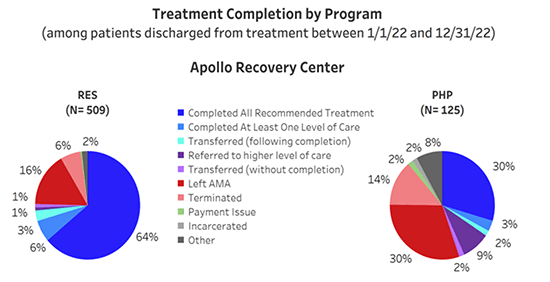
And when we see those things occurring, we deploy the appropriate interventions to prevent those AMAs. And I would say over the last few years, my AMA rate averages between 11 and 13%.
[Joanna]
So- And is there a particular touch point that you found really is helpful in identifying people who are on the wrong track?
[Chris]
Yeah, so like, we stole the best practice from Ritz-Carlton. At Ritz-Carlton, every employee is incentivized to really ensure that the customer has an outstanding experience. And so we identified that, you know, people are probably most vulnerable the moment they step through the door.
And so we really try to create a wonderful, you know, welcoming environment for them. One of the things that we started to do is we put up a plaque and we put welcome and we put the name or the names of the people arriving that day. And then when we go in the room, we try to put some, you know, we put like, we put their materials and stuff in the room so it feels like it's personalized.
And we just try to use some like, some hospitality touches to make the person feel welcome and make them feel seen and heard. So that's one thing we do. The other thing we do is, you know, medications.
You know, if you have a pharmacy on site, great. You're way ahead of us. We have to use third-party pharmacies.
If there's any disconnect in getting people the appropriate medications at the appropriate times, especially around sleep and insomnia, a lot of people coming off substances, don't sleep well. You know, one, two, three nights without good sleep, that person's out of here. So making sure they have the appropriate medications at the appropriate times. Being really good about setting expectations and letting the patient know what your timeframes are.
You know, folks are very anxious when they get here. In their mind, they think, hey, all I gotta do is get to Turning Point and then I'm gonna see a doctor, I'm gonna see a therapist, and they're gonna fix me up. And they don't understand that there could be 24, 48, 72-hour timeframes depending on when they're coming in and what they're doing, because we're not an acute hospital setting.
And so, you know, setting appropriate expectations. We could see where we had violated expectations in those surveys, because they'd say, hey, I didn't see a doc, and you know, blah, blah, blah. And it's like, well, when we measure, you know, our fidelity to our timeframes, we're fine.
But what we don't measure is we don't measure how well we set expectations. So maybe the problem isn't the timeframe, maybe the problem is the expectation.
[Joanna]
So satisfaction ratings that patients gave were helpful in this and seeing what, you know, whether they were-
[Chris]
Yeah, the satisfaction ratings are very helpful. You know, the medical team appreciates the data, especially when you're deploying SSRIs that take several weeks before they become effective. You know, it's one thing for a patient to sit across from you and say, hey, I'm doing really well. It's another thing when they've committed those thoughts to the, you know, the questions in Vista.
Week over week, it's the same question phrased the same way. They're familiar with it. They know the drill.
One of the things that we found is very interesting is that people just tend to be a lot more honest on the surveys than they are in person. You know, that story with Dave is a great example. For whatever reason, I think people feel a little more comfortable and they're able to be a little more vulnerable, which is a positive thing.
Yeah.
[Joanna]
Yeah, we've heard that a lot from other clinical users that they learn things through the surveys that sometimes patients don't talk about face to face. We're running out of time. A couple of other questions.
Vista does a number of different reports for you. Are there any particular reports you found really, that provided some really unusual insights?
[Chris]
Yes, there's some really great reports and I want to get into that, but I just thought of a best practice too that I want to share. And it's, you know, culture is a very difficult thing in an organization. You know, trying to figure out how to create the right culture can be a challenge because culture isn't something you can touch.
You know what I mean? It doesn't live in a system, can't measure on a spreadsheet, so to speak. The thing that we found is that by practicing fidelity to measuring outcomes, by educating patients that we are an outcome-oriented program, we sort of set the expectation both for staff and for patients that, when you come to Turning Point, we provide treatment that works and we expect you to be successful. And that implied expectation of success, it, becomes a self-fulfilling prophecy towards more success. It helps the staff feel more confident.
It helps the patients feel more confident and everybody's sort of oriented to the same goal in mind. Now it's no longer about completing the treatment episode. Now it's about completing the treatment episode in a meaningful way that leads to long-term successful outcomes.
And when I think of successful outcomes, it's not just a hundred percent abstinence. It's improvement in your quality of life, improvement in your level of functioning and finding a sense of purpose. Because I truly believe when people find those three things, abstinence is not as challenging, right?
But when you start with, hey, it's got to be a hundred percent abstinence. And then those other things come, it can be a little overwhelming for someone in early recovery. So one of the other benefits of measuring outcomes, having a platform to report and distribute your outcomes is it creates a culture where everyone sort of leans in towards the expectation that we're here to achieve something very definitive.
Yeah. The other key benefits we talked about the reports, you know, you get two reports, you get your supplemental report, and then you get your Clinician Effectiveness Report. Um, the supplemental report for me as a CEO is very helpful in guiding my strategic thinking, because one thing it does is it, you know, there's a lot of really wonderful demographic information in there.
And I know that, like, I know who our, I know who our ideal population is. I know how old they are. I know what their educational background looks like.
I know what their income levels look like. I know whether they went to college or not, whether they graduated high school or not, whether they own homes or not, whether they're married, divorced, single, I know all those things about our population. And so, one, I get to look year over year at is my population serves changing.
And if it is changing, how is it changing? And what do I need to do to meet the needs of this changing population? So it's very informative in terms of strategic thinking and looking ahead.
Um, the other thing it does is, you know, just tells you straight up, how are you doing relative to your competitors? Are you as good as the people down the street or the people in the next state or the next region? Um, the other thing it's been very helpful is, you know, I've, I've got a number of colleagues and, and, and I call them competitors, but we're all here for the same reason.
We're all here to help people. Right. And, and when I'm able to look at how's Turning Point doing relative to the other folks in my market, you know, we have some challenges in Utah that we don't have in other places in terms of the levels of depression, the levels of suicidality, some of the risks that we deal with.
And when I see that, hey, my competitors are dealing with this too. It just helps you feel like we're not alone. And it's also, there's been a couple of points where it's like, you know, I'm going to pick up the phone and I'm going to call this person because I want to ask them what they're experiencing and what they're doing.
And I think it's opened up some pathways to collaboration that maybe I wouldn't have thought about because I wouldn't have realized -- Oh, this person that I know, they're dealing with this too. They're, you know what I mean, they're facing this challenge too.
So those are some ways that the supplemental reports are helpful. Obviously just being able to compare year over year, your effectiveness in any of the dimensions that are measured is very good. Being able to look at that, like if you're running process improvement initiatives or you have turnover, you have changes in the way you do things. You're able to, you're able to look at that and you're able to say, Hey, are we doing better or worse relative to years past?
So it's just a great benchmarking tool and, you know, it kind of strips away a lot of the self delusion that we, that we find ourselves dealing with.
[Joanna]
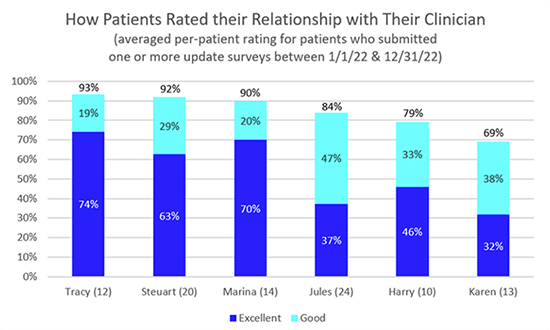
And how about one of the things we've added more recently is the individual data on the clinicians.
[Chris]
Yeah. So the Clinician Effectiveness Report is super helpful. There's a, you know, one, it gives you an opportunity to go in there and really celebrate people who are thriving and doing a great job.
And, uh, let's face it. We all like being recognized. We all like being validated.
Everybody does better when our hard work is acknowledged. And so, uh, that's an area where the Clinician Effectiveness Report can be very helpful. The other place where that can be very helpful is, you know, you can have a clinician who's incredibly talented at affecting change, at building therapeutic alliance, at making sure people cross the finish line.
But this might be your clinician that you're emailing two or three times a week – “your UM is late again. You're putting this person at risk”.
“Hey, your documentation's a little lackluster. Hey, we just did our chart audits and yet again, we have to talk to you”. And so this person in your mind, you're like, you know, they're kind of a B player.
They're kind of on the struggle bus. But then when you get your Clinician Effectiveness Report, you're like, Oh! Actually they're just really, really good at their primary, you know, objective, which is facilitating change. And this other stuff maybe doesn't resonate enough with them.
And it kind of helps you think a little differently about maybe I should be thinking about some different processes, different tools, different workflows, different supports, resources to help them because they're truly a gem and people are getting very well. It just doesn't maybe look like that from the, you know, from the nuts and bolts perspective, if you will.
[Joanna]
I had one more question. You have been able to show some of our outcomes to payers along the way. Has that, you know, has that facilitated any new agreements or contracts?
[Chris]
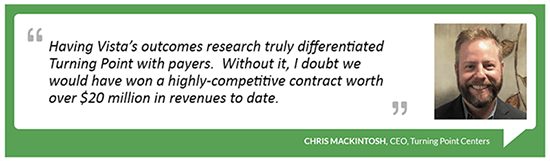
Yeah. So I think where Vista has really helped us is one, we're able to, we're able to show - the fact that we have the data differentiates us with our payers. So when we walk into those contracting conversations, we're already head and shoulders above the competition because we're coming prepared.
So that's one area that it helps us. Two, we've been in a, we've been in an environment the last several years where reimbursement rates are relatively flat relative to, you know, increases in operating expenses, particularly with behavioral health wages, as there's more demand for, for this type of healthcare. So, that is, that has really helped us be able to say to a few key payers, like, “Hey, look, we know you're a little reluctant to sort of give us this increase, but if you don't give us this increase, this is what we have to give up. And this is where we can draw a correlation or causation between how this thing is important to the outcomes being measured”.
So instead of just speaking hypothetically, we're speaking in definitive factual terms. The third thing where it's really helped us is it's given us the confidence to enter into value-based agreements where we're able to realize some upside and some additional revenue as a result of the great work that we do, because, you know, in a value-based agreement, you have to take on some risk. Well, you know, nobody wants to take on risk unless you understand the nature of the risk and you have a plan to mitigate that risk.
And so, for example, we entered into a value-based agreement where if we hit certain, you know, HEDIS measures, seven day follow-up, 30 day follow-up, 30 day return to treatment rates, we were going to get, you know, additional increases for every single patient we treated the following year. And those incremental dollars are substantial. They fall directly to the bottom line and where we're experiencing margin compression and it's so competitive for patients, that's a very important tailwind, right?
So it gave us the confidence not only to enter into those value-based agreements, but we were able to produce outsized outcomes relative to the other people in the value-based agreements to the point where our HEDIS measures were, were two to three times our competitors, two to three times our competitors! And the reality is, um, as once you decode your continuum of care and once you understand where your strengths are and where, where you need to, to pay a little more attention, it's a lot simpler than you think it really is. You're not as far off from achieving clinical excellence as you may believe. But it all starts with measuring the outcomes, giving the outcomes to the people doing the work, right?
Making sure you're practicing fidelity and then applying, applying what you're learning along the way.
[Joanna]
That's fantastic. Chris, I'm going to have to cut it off here. Thank you so much for sharing your experience.
It's been a pleasure to work with you for the last seven years, and I hope we work for the next seven plus in the future. So thank you again.
[Chris]
Yeah, I do want to say one last soundbite. You know, in the beginning of the call, I said, you know, your product was easier for us to implement and execute than anything we could think up ourselves. So we were really truly just trying to meet a regulatory requirement.
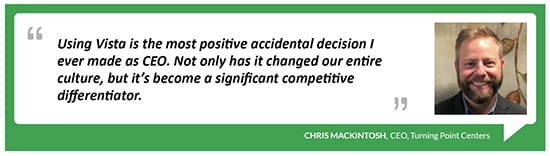
But the reality is, is that the measurement of our outcomes and what we learned from measuring our outcomes became a significant competitive differentiator, and so it, it was the most positive accidental decision I ever made as a CEO.
[Joanna]
I love it. Chris, thank you so much.
[Chris]
You're welcome. Thank you.