


Many addiction treatment centers today say that providing excellent care to their patients is the easy part. A bigger challenge is negotiating a fair rate with their health plans that allows them to stay afloat.
On February 19, 2026, I asked the co-founders of The GrowthMD, Maks Danilin and Ryan Soave, for their negotiating advice. They suggested the following:
The secret to success is developing a truly collaborative relationship with the major health plans in your area. Ask to meet with your Contracting manager well in advance of your next negotiation for the purposes of getting to know one another. Perseverance is key as it may take multiple outreach attempts to schedule the first meeting. Being very clear that “this isn’t a rate discussion meeting” can help.
In your first meeting, focus on understanding what initiatives they’re being asked to achieve and how they score treatment centers. Try to identify areas in which your center excels that meet a specific need of the health plan.
Look for opportunities to build relationships with representatives in other areas of the health plan, such as in Billing, Strategy, Case Management or Network, by proposing joint initiatives. Continue to cultivate these relationships over time, perhaps by meeting quarterly to report on progress.
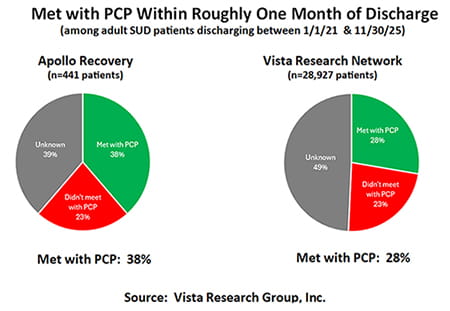
Create narratives that translate key quality metrics into payer cost savings. For example, if your health plan has an initiative to encourage patients to meet with their primary care provider (PCP) shortly after treatment, commit to helping the health plan achieve this. Ask your team to make a PCP appointment for your patients before they leave and then follow up with the doctor’s office afterwards to make sure they attended.
Then before your next meeting with the health plan, ask Vista to summarize the percentage of the payer’s members who reported visiting their PCP on their one month post-treatment survey and compare your results to the Vista norm. The health plan will be impressed by your ability to confirm that 38% of your patients saw their PCP in their first month after discharge, which is well above Vista’s 28% norm for adult SUD centers:
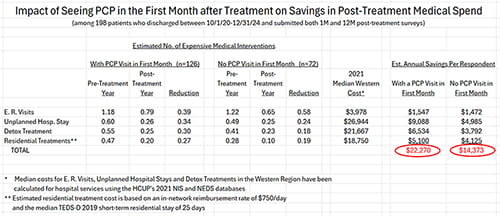
Then ask Vista to calculate how the savings in post-treatment medical spending differed for this payer’s members between those who saw their PCP in the first month after treatment and those who didn’t. In this case, payer members who visited their PCP in the first month after treatment are estimated to have saved $22,270 in expensive medical interventions in the post-treatment year versus what they were spending in the year prior to entering treatment. By comparison, members who did not visit their PCP in the first month are estimated to have saved only $14,373:
Vista can do similar analyses for a wide variety of actions that payers may prioritize, such as stepping down to lower levels of care, visiting a therapist, taking anti-craving or psychotropic medication, attending recovery support meetings, etc. To learn if Vista collects data on a metric your payer requests, please reach out to our support team.
When it is time to negotiate with the payer, start by focusing on what your center does particularly well. Barging into the meeting arguing that “we need to raise our rates” is unlikely to work.
Competitive rate information can be useful in understanding what other treatment centers in the market are being paid. A good plan is to aim for the 75th percentile; you don’t want to be an outlier in the market.
In addition to rates, there are other factors that may be useful to negotiate, such as payment terms or reducing pre-authorizations. For example, one of The GrowthMD’s clients had terms that didn’t allow them to bill for detox until the patient had completed the entire continuum of care. Receiving approval to bill for each level of care as soon as it was completed was a big win.
This article is a brief summary of the topics Maks and Ryan discussed during the first ‘Delivering Recovery’ interview on February 19, 2026. You can watch the full interview here:

To learn how your center can work directly with The GrowthMD, contact Maks at Maks@TheGrowthMD.com